How to Create a Career Comeback Plan
A 5-step plan to assess skills, explain gaps, update credentials and profiles, and relaunch your job search.


Setbacks in your career are normal, but how you handle them defines your next step. Whether you're recovering from layoffs, skill gaps, or a career break, this guide gives you a clear, actionable plan to bounce back. Here's the process:
- Assess your skills: Identify strengths, gaps, and areas to improve.
- Reframe your career gap: Learn how to explain breaks confidently and professionally.
- Update your skills: Focus on in-demand tools or certifications relevant to your target role.
- Polish your resume and LinkedIn: Tailor them to highlight growth and readiness.
- Reconnect and apply: Network strategically and treat your job search like a project.
Key takeaway: Success comes from a structured approach, consistent effort, and a clear story about your career journey. Start today by evaluating where you are and setting specific, measurable goals.
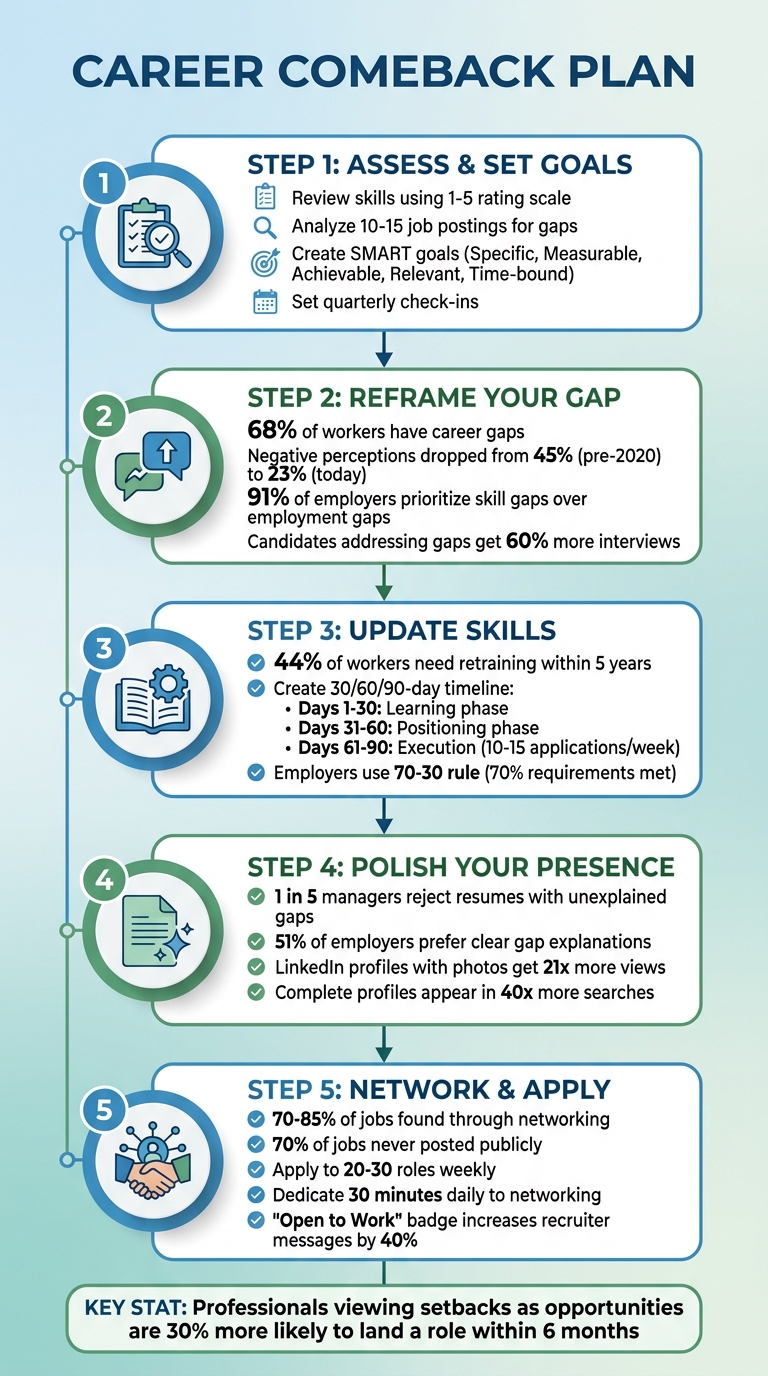
5-Step Career Comeback Plan: From Assessment to Job Offer
Career Break? Here's How to Make a Strong Comeback #careercomeback #CareerBreakSuccess
sbb-itb-ba81f5d
Step 1: Review Where You Are and Set Clear Goals
Before making any moves, take a step back and assess where you currently stand. This gives you a solid starting point to build from.
Review Your Skills and Experience
Start with a personal career check-up. Grab a spreadsheet and list out your hard and soft skills, rating each on a scale of 1 to 5. This simple exercise gives you a clear picture of your strengths and areas that need work.
Next, document your achievements in a way that shows real impact. For example, instead of saying, "managed social media", write something like, "increased Instagram engagement by 34%, growing followers from 2,500 to 8,900." Numbers make your accomplishments stand out, whether you're updating your resume or preparing for interviews.
Take a look at 10–15 job postings in your target field. This helps you identify any gaps in your skill set. For example, if most roles mention Tableau and you've never used it, that's a clear area to focus on.
You can also gather external insights. Performance reviews, feedback from colleagues, or advice from mentors can offer valuable perspectives. A SWOT analysis (Strengths, Weaknesses, Opportunities, Threats) is another great way to pinpoint where you need to grow.
Once you've done this deep dive, you're ready to set clear, actionable goals.
Create SMART Goals
The SMART framework is your go-to for goal setting: Specific, Measurable, Achievable, Relevant, and Time-bound. For instance, instead of saying, "I want a better job", try something like, "Transition to a Senior Marketing Manager role within 12 months by earning a Google Analytics certification by July 15, 2026, and networking with five industry leaders monthly."
Break your big-picture goal into smaller, manageable milestones. Let’s say your ultimate aim is to become a Director of Operations in three years. Your first step might be earning a PMP certification by September 30, 2026, or leading a cross-functional project by December 2026.
Accountability is key. Share your goals with a mentor or trusted colleague and set quarterly check-ins to evaluate your progress. This keeps you on track and allows you to adjust if needed.
"The only person you are destined to become is the person you decide to be." - Ralph Waldo Emerson
Step 2: Change How You Talk About Your Career Gap
After assessing your skills and setting SMART goals in Step 1, it's time to reframe the way you discuss career gaps. Did you know that more than 68% of workers have experienced a career gap? In fact, 69% of professionals have at least one gap on their resume. Since the pandemic, career breaks have become more normalized, with negative perceptions dropping from 45% before 2020 to just 23% today. The secret is in how you present them.
Explain Career Gaps Professionally
Honesty is crucial - always include accurate dates to maintain credibility. Instead of avoiding the topic, confidently address your gap by focusing on the skills and experiences you gained during that time.
For gaps shorter than three months, it’s usually not necessary to mention them on your resume. Just be ready to explain if the topic comes up during an interview. For gaps lasting between three and 12 months, consider using years-only formatting (e.g., "2024–2025") to downplay the gap. If your gap extends beyond 12 months, include a formal entry on your resume titled "Career Break" or "Professional Sabbatical." Use two to three bullet points to highlight productive activities or accomplishments during that period.
Here’s how to professionally frame common gap reasons:
| Reason for Gap | Example Explanation |
|---|---|
| Layoff | "Position eliminated due to restructuring; used time to pursue certification." |
| Caregiving | "Planned sabbatical for family care; developed project management and resilience." |
| Health | "Focused on a personal health matter that is now fully resolved; ready to return." |
| Upskilling | "Completed advanced training in data analytics to align with emerging industry trends." |
| Travel | "Intentional sabbatical for cultural immersion and adaptability skills." |
To prepare for interviews, create a concise script that explains your gap. Include the reason for the break, highlight your accomplishments during that time, and emphasize your readiness to return. For example:
"I took a planned break to care for a family member. During that time, I completed a project management course and volunteered with a nonprofit organization. I'm now fully available and eager to contribute my enhanced skills to this role."
Once you’ve explained your gap, use the redirect technique to shift the focus back to the role. For instance, follow up with a specific question about the position to steer the conversation toward your future contributions.
"Employment gaps don't define your career - they can highlight your resilience in a changing world." - CareerBoom.ai
It’s worth noting that 91% of employers are more concerned about skill gaps than employment gaps. Candidates who proactively address their breaks and demonstrate growth often land up to 60% more interviews.
With your explanation polished, it’s time to focus on rebuilding your confidence for interviews.
Build Your Confidence Back
Addressing a career gap is just one part of the process - rebuilding your confidence is equally important. Start by creating a Gap Skills Inventory. Take note of every course, volunteer project, or freelance gig you completed during your break. You might be surprised at how many transferable skills you’ve gained, from crisis management to budgeting.
Use empowering language to describe your break. Replace phrases like "was unemployed" with "dedicated time to professional development" or "focused on building new skills." Counter self-doubt by listing achievements that prove your value. If you’re worried about being out of practice, recall a time you excelled under pressure to remind yourself of your strengths.
Take a few minutes each day to visualize success. Picture yourself walking into an office, contributing in meetings, and solving problems. This mental rehearsal can gradually boost your confidence. Additionally, reconnect with former colleagues on LinkedIn. Send personalized messages to rebuild your professional network and regain a sense of assurance.
"A career break doesn't erase your skills or experience. It's just a chapter of your journey." - Maria Galetta, Leadership and Career Coach
Finally, shift the focus from why you took a break to why you’re ready and excited to contribute now. Your gap doesn’t define your career - what you do next does.
Step 3: Update Your Skills and Make a Timeline
With your confidence restored and a clear story to tell, it's time to focus on the skills that will fuel your career comeback. Did you know that 44% of workers will need to update or retrain their skills within the next five years to keep up with evolving job demands?. The key is not to overwhelm yourself by trying to master everything at once - focus on one skill at a time.
Find Out What Skills You Need
Start by identifying 2–3 specific job titles you're aiming for, like Digital Marketing Manager or Customer Success Manager. Then, pick 5–10 companies you'd love to work for.
Next, dive into job descriptions for your target roles - review five to ten postings and copy the "Requirements" sections into a document. Pay attention to trends. Which hard skills (like Python, Salesforce, or Tableau) keep popping up? What soft skills (like stakeholder management or teamwork) are mentioned frequently? To go deeper, check out LinkedIn profiles of professionals in similar roles to uncover common skills and certifications.
Create a Skills Gap Analysis by comparing the skills you already have with the ones listed in job descriptions. Categorize each skill as "Have It", "Partial", or "Gap." For every skill you list as "Have It", back it up with a concrete example, such as: "Used SEO keyword research to boost organic traffic by 20%." Don’t overlook soft skills - hiring managers often prioritize abilities like communication and adaptability. If you're unsure about your self-assessment, reach out to former managers or mentors for feedback on your strengths and areas to develop.
Once you've identified your skill gaps, it's time to plan how you'll close them.
Build a 30/60/90-Day Plan
Break your comeback into three phases: Days 1–30 for learning, Days 31–60 for positioning, and Days 61–90 for execution.
- Days 1–30: Start with a skills audit and enroll in an online course or certification program to address your most critical gap. Update your master resume to reflect any new accomplishments.
- Days 31–60: Shift your focus to positioning yourself. Update your LinkedIn profile with the skills you've gained, create a portfolio or volunteer project to showcase your work, and reconnect with your professional network.
- Days 61–90: It's time to execute. Submit 10–15 tailored applications each week and schedule informational interviews with people in your target industry.
Here’s an example of how this plan can work: One professional used a similar strategy and saw her interview rate soar. She took a 4-week online course to close a key skill gap, applied to 12 targeted roles, and landed a new job with a 20% salary increase.
"Recovering from a career setback isn't a sprint; it's a strategic marathon." - Resumly
Keep in mind that many employers follow the 70-30 rule - they're willing to hire candidates who meet 70% of the job requirements if they show they can learn the rest on the job. Your timeline doesn’t have to be flawless; it just needs to show you're making progress. This approach highlights your growth and dedication, which is what really matters.
Step 4: Update Your Resume and Online Profiles
Now that you've mapped out your skills and timeline, it's time to craft a resume and online presence that tell the story of your career journey. Here's a reality check: 1 in 5 hiring managers will reject a resume outright if it has an unexplained employment gap. But there's good news - 51% of employers are more likely to reach out if you clearly explain the reason for your career gap. So, transparency and thoughtful presentation are key.
Improve Your Resume and Work Samples
Consider using a combination resume format that highlights both your skills and your career timeline. It's important to directly address any gaps - titles like "Career Transition Period", "Sabbatical", or "Family Caregiving" can provide clarity. If you took on freelance work, earned certifications, or volunteered during your break, list these as valid experiences. Be specific: instead of leaving months unaccounted for, include titles like "Independent Consultant" and detail the deliverables or outcomes.
Focus on quantifiable results in your bullet points. For example: "Increased ROI by 22%" or "Managed a $500,000 budget". Remove outdated tools and emphasize current skills or certifications to show you're ready for the demands of today’s job market. Also, make sure to include keywords from your target job descriptions to pass Applicant Tracking Systems (ATS), which filter resumes for over 90% of large employers.
"The career break is one chapter of your professional story - not its defining feature." - 0Portfolio Team
To streamline the process, tools like ResumeFast, ResuFit, and Rezi provide ATS-friendly templates and AI assistance. If you need to showcase work samples, platforms like 0Portfolio allow you to build a professional portfolio without any coding skills. Save your resume as "FirstName-LastName-Resume.pdf" to ensure proper formatting and a polished presentation.
Once your resume is ready, extend this same attention to detail to your online profiles.
Refresh Your LinkedIn and Online Presence
LinkedIn is more than just an online resume - it's a platform to position yourself for your next role. Start with your headline, which is crucial for search visibility. Use the full 220-character limit to clearly state your target role, unique perspective, and value proposition.
In the "About" section, structure your story into three parts: The Bridge (how your past connects to your future goals), Transferable Value (examples of skills or accomplishments), and Forward Focus (what you're working on now). LinkedIn also offers a "career break" feature, allowing you to categorize gaps as parenting, caregiving, health, or personal development. This normalizes non-linear career paths and eliminates guesswork.
A professional photo is a must - profiles with photos get 21x more views and 36x more messages. Pin your most recent certifications, volunteer work, or portfolio projects in the "Featured" section to show you're keeping your skills sharp. Aim to collect 5–10 solid recommendations from former colleagues or managers to strengthen your credibility.
Engagement on LinkedIn can also boost your visibility. Spend 30 minutes a day interacting with industry posts - the platform's algorithm favors active users, increasing your search ranking. Profiles completed to "All-Star" status show up in 40x more searches than incomplete ones. And remember, 62% of hiring managers are open to hiring professionals returning from a career break. But they can't hire you if they can't find you.
"Write your profile for the job you want, not the job you have." - Emily Worden, Career Coach
Step 5: Reconnect with Your Network and Start Applying
Now that you've revamped your resume and LinkedIn profile, it's time to focus on networking and job applications - two essential steps for moving forward. Networking can uncover hidden opportunities, with studies showing that 70–85% of jobs are landed through personal connections, and about 70% of openings are never posted publicly. Plus, people who secure jobs through networking often report better pay and higher satisfaction. Here's how to reconnect with your network and approach your job search with purpose.
Reconnect with Former Colleagues and Contacts
Start by revisiting your existing network before trying to make new connections. Look through your contact list and LinkedIn connections - it’s far easier to rekindle old relationships than to build new ones from scratch. To keep things organized, group your contacts into three categories:
- Operational: Current or recent colleagues.
- Personal: Industry peers or acquaintances.
- Strategic: Mentors, hiring managers, or influential professionals.
When reaching out after a long time, avoid sounding overly eager or desperate. Personalize your messages by referencing shared experiences or offering something of value, like a helpful article or a thoughtful comment on their recent post. Instead of diving straight into job inquiries, frame your outreach as a request for insight. For instance, ask for a brief call to learn about their career journey or their company’s culture. These conversations can naturally lead to discussions about opportunities.
"If the only time anyone hears from you is when you need a referral, you are not networking, you are cold-calling people who already know your name." - Mokaru Team, Career Development Experts
Dedicate 30 minutes each day to networking activities. This could include reaching out to new contacts, following up with existing ones, or sharing content on LinkedIn. Posting a thoughtful update about an industry trend or a lesson you’ve learned once a week can help you stay visible. After every meeting, send a thank-you note within 24 hours and follow up a few months later to share how their advice helped you.
Approach Your Job Search Like a Project
Once you've reestablished connections, treat your job search as a structured project. Set clear weekly goals to stay on track. In 2026, a typical job search involves submitting 20–30 applications per week, while a more aggressive strategy might require 50+ applications to land 10–15 interviews in the first month. Acting quickly after a layoff can shorten your search to 2–4 months, while delays can stretch it to 6–12 months.
Break your week into manageable tasks:
- Monday: Research five new companies.
- Tuesday: Tailor your resume for specific roles.
- Wednesday: Submit applications for targeted jobs.
- Thursday: Practice interview responses using the STAR method.
- Friday: Send five personalized LinkedIn connection requests.
Set weekly targets, such as five networking conversations and ten tailored applications. Track your progress by keeping tabs on metrics like applications sent, interviews scheduled, and new connections made. Consistency is key - apply steadily until you secure an offer.
Using tools like LinkedIn’s "Open to Work" badge can increase recruiter messages by 40%. And remember, how you frame your story matters. Professionals who view setbacks as opportunities for growth are 30% more likely to find a new role within six months. Your success will come from deliberate, sustained effort - not chance.
"Networking isn't just about what others can do for you; it's also about how you can add value to their lives." - Dawne Brooks Gulla, Professional Speaker and Consultant
Conclusion: Start Your Comeback Today
Career setbacks don’t define your future - how you respond does. Now you have a roadmap: evaluate your current situation, reframe your career gap, update your skills, refresh your resume and LinkedIn profile, and reconnect with your network. The difference between a temporary challenge and a long-term stall lies in consistent effort and the right mindset.
This plan gives you a solid starting point for progress. Research shows that professionals who view setbacks as opportunities to learn are 30% more likely to land a new role within six months. Treat your comeback like a project: set clear weekly goals, dedicate focused time each day to learning and networking, and measure your progress through metrics like applications sent, connections made, and interview invitations.
"Career setbacks don't end careers - but the shame, isolation, and strategic mistakes people make while recovering from them often do." - Focus Dividend
Begin today with a simple step: conduct a personal career audit. Write down your hard and soft skills, rate your expertise in each, and identify specific areas where you need improvement. Then, calculate your financial runway to determine whether you need immediate income or have the flexibility for a 3–6 month recovery plan. Starting with this clear assessment removes uncertainty and gives you a practical foundation.
Every small step moves you closer to your goals. Whether it’s updating your LinkedIn headline, reaching out to a former colleague, or enrolling in a certification course, action creates momentum. Your comeback starts the moment you take control of your story and move forward with intention.
FAQs
What should my 30/60/90-day comeback plan include?
A well-structured 30/60/90-day plan can help you stay focused and make steady progress during a career transition. Here's how to approach it:
- First 30 Days: Start with self-reflection. Take a close look at your strengths, skills, and areas where you can improve. This is the time to understand what you bring to the table and identify gaps you want to address.
- Days 31–60: Shift your focus to action. Update your resume to highlight your most relevant skills and achievements. Use this period to build or sharpen skills that align with your career goals. Networking becomes key here - start reaching out to connections and actively engage in professional communities.
- Days 61–90: It’s go time. Begin applying for jobs that match your goals and prepare thoroughly for interviews. Use any feedback you receive to fine-tune your applications and interview strategy. Stay adaptable and refine your plan as needed.
This framework isn’t one-size-fits-all - adjust it based on your specific objectives and career aspirations.
How do I explain a long career gap in interviews?
When addressing a career gap, focus on how you made the most of that time. Briefly explain the reason for the gap - whether it was caregiving, health-related, travel, or job loss - and shift the focus to what you accomplished during that period. Did you pick up new skills, earn certifications, or engage in personal development? Highlight those achievements confidently and frame the experience as something that has prepared you for your next role. Employers increasingly appreciate candidates who demonstrate initiative and commitment to staying engaged during career breaks.
Which skills should I learn first for my target role?
When deciding which skills to build, consider your career goals and the demands of the industry you’re aiming for. Start with core skills that are essential for your desired role. These might include technical abilities that are currently in high demand, soft skills like effective communication, or certifications that directly support your ambitions.
Make skill-building a daily habit. Set aside time each day to learn, practice, and grow your expertise. Don’t forget to network - connecting with others in your field can open doors and provide insights that help you refine the skills needed to succeed.