How to Trust Your Gut in Risky Situations
True gut instincts are calm, experience-based signals—learn to spot anxiety, train intuition, and balance it with logic.


Trusting your gut can help you make quick, effective decisions, especially when under pressure. Your intuition works by recognizing patterns from past experiences and sending signals through physical sensations like calmness or unease. But it’s not foolproof - gut instincts work best in familiar, predictable situations and can falter in chaotic or uncertain environments. The key is learning to distinguish between intuition and fear, as fear often feels urgent and overwhelming, while intuition provides a calm sense of knowing.
Key Takeaways:
- Gut instincts rely on your brain’s ability to process subtle, unconscious cues.
- When it works best: High-pressure situations with clear patterns (e.g., firefighting, emergency medicine).
- When it falters: Unpredictable scenarios like stock market predictions.
- Intuition vs. Fear: Intuition feels calm and present-focused; fear is anxious and future-oriented.
- How to improve: Start small, track your decisions, and balance intuition with logic for critical choices.
By practicing with low-stakes decisions and learning to identify physical and emotional cues, you can strengthen your instincts and use them effectively in both everyday and high-stakes situations.
Trust Your Gut? 5 Times You Should - and 5 Times You Shouldn't
sbb-itb-ba81f5d
How to Tell Intuition from Fear
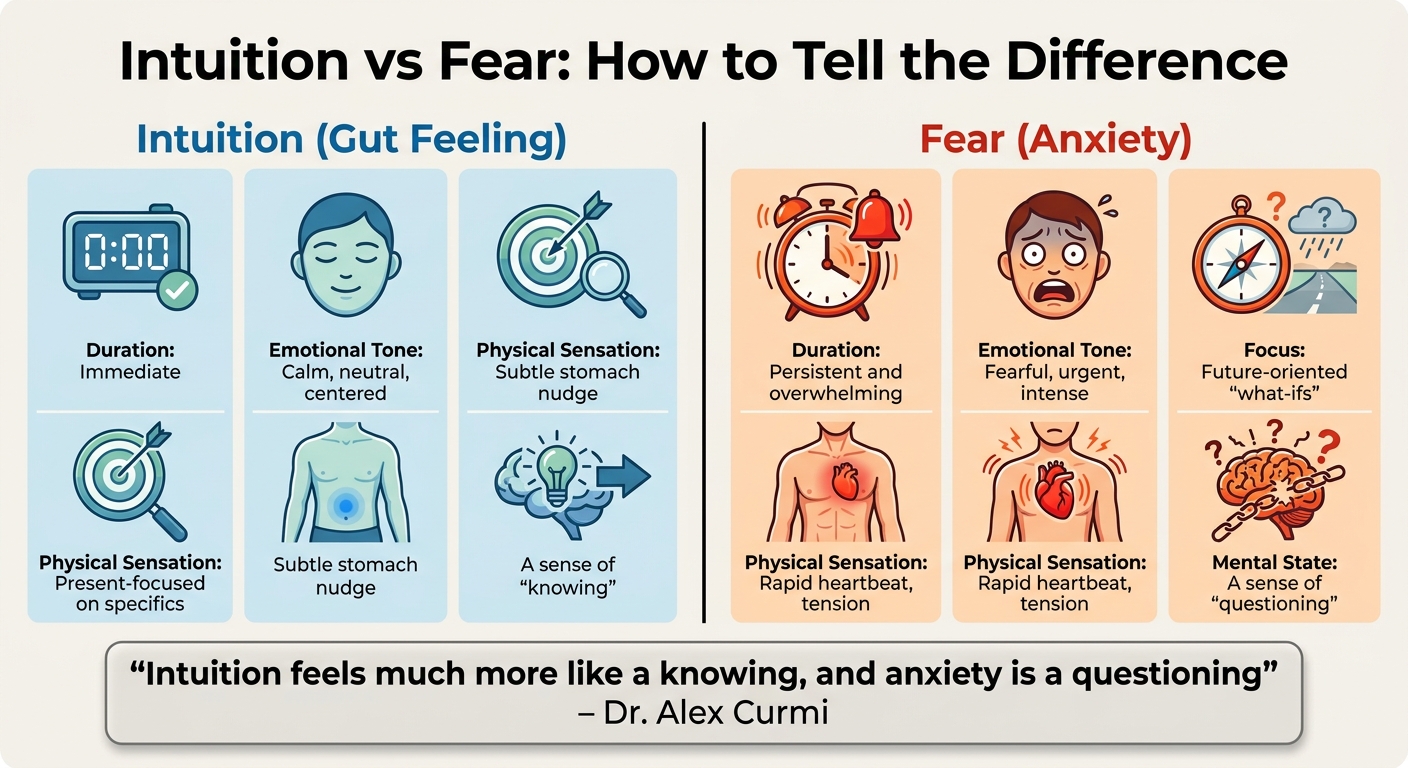
Intuition vs Fear: Key Differences in Decision Making
Distinguishing between genuine intuition and fear can be tricky. Both can manifest as physical sensations, but they lead to very different outcomes. While fear often drives avoidance and withdrawal, true intuition encourages calm, informed action. This difference is especially critical when making decisions under pressure. Psychiatrist and psychotherapist Dr. Alex Curmi puts it simply:
"Intuition feels much more like a knowing, and anxiety is a questioning".
Recognizing these contrasts becomes even more vital in high-stakes situations.
What Intuition Feels Like
True intuition has a unique, identifiable quality. It often arrives as a calm and neutral sense of "knowing", specific to the current moment or situation. Physically, it may feel like a gentle nudge, sometimes even slowing your heart rate. These signals allow your brain to guide decisions before you fully process the reasoning behind them.
Fear, on the other hand, is loud, persistent, and emotionally charged. Instead of calm clarity, it brings a sense of urgency and dread, often accompanied by spiraling "what-if" thoughts. Physically, fear can manifest as a racing heartbeat, stomach discomfort, tightness in the chest, or a restless energy that’s hard to shake. Therapist April Kilduff offers this caution:
"When you have an anxiety disorder, 'go with your gut' is not always great advice, because your gut is always telling you to escape or distract… and you actually need to do the opposite".
The key differences lie in how long the sensation lasts and what it focuses on. Intuition tends to show up briefly and is tied to the present, while fear lingers and loops through imagined future scenarios.
| Dimension | Intuition (Gut Feeling) | Fear (Anxiety) |
|---|---|---|
| Duration | Immediate | Persistent and overwhelming |
| Emotional Tone | Calm, neutral, centered | Fearful, urgent, intense |
| Focus | Present-focused on specifics | Future-oriented "what-ifs" |
| Physical Sensation | Subtle stomach nudge | Rapid heartbeat, tension |
| Mental State | A sense of "knowing" | A sense of "questioning" |
These differences offer valuable clues for navigating strong emotions.
Questions to Ask Yourself
When a strong feeling arises, take a moment to pause. Start by taking deep breaths and paying attention to how your body reacts. Intuition tends to bring a brief sense of calm, while fear ramps up tension. Then, ask yourself: "Is this feeling based on the present moment, or am I reacting to imagined threats?" If there’s no clear evidence in the present, it’s likely fear rather than intuition.
It’s also helpful to reflect on whether the feeling connects to past experiences. Intuition often draws from patterns you’ve encountered before, while fear may stem from trauma or learned biases that distort your natural instincts. Finally, assess the urgency. If the emotion demands immediate, panicked action, it’s probably fear. Keeping a journal to track these sensations over time can help you identify whether recurring "gut feelings" are rooted in anxiety rather than true intuition.
How to Build Trust in Your Intuition
Trusting your intuition takes time and practice, much like honing any other skill. The encouraging part? You don't have to start with major, life-altering decisions. Instead, begin with smaller, low-stakes situations to gradually strengthen your instincts. Think of it as training your subconscious mind. Cognitive neuroscientist Sara Laszlo explains this beautifully:
"Intuition is practicing so much it feels like magic".
The foundation of trusting your intuition lies in building a personal track record. By keeping track of your intuitive decisions and their outcomes, you create tangible proof of when your instincts were accurate. This helps replace uncertainty with confidence. Considering the average person makes about 35,000 decisions daily, there's no shortage of opportunities to practice.
Let’s dive into some practical ways to refine and test your intuition.
Practice with Small Decisions First
Start by relying on your gut for everyday decisions that carry little risk. These could be simple "yes or no" choices where the stakes are low, such as deciding whether to take the highway or side streets, choosing between a salad or a sandwich, or accepting or declining a casual coffee invitation. Focus on the very first answer that comes to mind before logic steps in.
To track your progress, try keeping an intuition log for two weeks. Record the decision, your initial gut feeling, and the outcome. Over time, this practice can help confirm how your instincts play out in daily life.
Also, pay attention to how your body reacts during these small decisions. Some people experience a warm, expansive feeling in their chest when something feels right, while others might notice a tightening in their throat or a sinking sensation in their stomach when something feels off. Intuition can also manifest through visual flashes (clairvoyance), sudden insights (claircognizance), or emotional shifts (clairempathy). Recognizing your unique style of intuitive signals makes it easier to trust them.
Use Mental Rehearsal
Once you’ve built confidence with smaller choices, you can practice with more complex scenarios through mental rehearsal. Picture yourself in a challenging situation and observe your physical reactions. Does your chest feel open and light, or does your throat tighten? These bodily cues reflect your subconscious response.
For slightly higher-stakes decisions, try a pre-mortem exercise. Imagine that a project has failed a year from now, then work backward to identify the warning signs or gut feelings you might have overlooked. This approach helps sharpen your ability to catch intuitive red flags before a crisis unfolds. To minimize risk, set an "affordable loss" limit for these experiments.
Combining Intuition with Logic
Once you've honed your intuition in low-stakes scenarios, the next step is blending it with logic for more critical decisions. Intuition can be a powerful tool, but it works best when balanced with rational analysis. While your gut instinct draws on patterns from past experiences, it still needs a reality check to ensure accuracy.
The trick lies in knowing when to lean on intuition. It tends to shine in stable, predictable environments but struggles in chaotic or uncertain situations. For example, consider the long-term performance of stock picking: over a 15-year period, 87% to 92% of actively managed large-cap funds underperform the S&P 500. This demonstrates that gut feelings alone often fail to outperform hard data in volatile settings.
When intuition and logic seem to be at odds, see it as a signal to pause and reassess. This tension often indicates missing information or the influence of bias. Daniel Kahneman, author of Thinking, Fast and Slow, offers a critical reminder:
"The confidence that people have in their intuitions is not a reliable guide to their validity".
In other words, feeling confident about a decision doesn’t guarantee it’s the right one. The next step is learning how to verify those gut instincts using pattern recognition and statistical evidence.
Pattern Recognition in Decision Making
Intuition thrives on pattern recognition, which is your brain's ability to match current situations with past experiences. This skill works best when you've had plenty of practice with clear and timely feedback. Over time, this feedback sharpens your instincts, making them more reliable.
To test your intuition, try identifying the specific cues that triggered it. For instance, what made you uneasy about a job offer or excited about a potential business deal? Was it someone's tone of voice, an inconsistency in their story, or a familiar situation from your past? If you can’t pinpoint anything concrete, your gut feeling might be more emotional noise than genuine insight.
Another useful tool is a base-rate check. Compare your gut feeling against statistical reality. For example, if your intuition predicts success in a field with only a 10% success rate, ask yourself: What evidence supports this feeling? This doesn’t mean dismissing your instinct outright - it means holding it accountable to the facts. By combining experiential knowledge with logical validation, you create a stronger framework for making decisions.
While these objective checks refine your instincts, your core values provide the ultimate test for their authenticity.
Check Against Your Values
Your core values serve as a compass for evaluating whether your intuition is leading you in the right direction. When a decision conflicts with your values, it often shows up as physical discomfort - like a knot in your stomach, tightness in your chest, or a vague sense of unease.
To assess this alignment, try a simple exercise: visualize yourself making one choice (Option A) and notice how your body reacts. Does your chest feel light and open, or does your throat tighten? Then, repeat the exercise with another choice (Option B). These physical sensations, known as somatic markers, can reveal whether a decision aligns with your values. Even if a choice seems logical on paper, it may trigger physical resistance if it goes against what you deeply believe.
This kind of self-check is especially important in high-pressure situations where emotions like fear or excitement can cloud judgment. Authentic intuition often feels like a calm and neutral clarity, rather than being emotionally charged. So, before making a risky career move or a significant investment, ask yourself: Does this decision align with my core values, or am I being influenced by external pressures like ego, fear, or societal expectations? The answer can help distinguish true intuition from emotional impulses.
Using Gut Instincts in High-Pressure Situations
Building on the practice of trusting your instincts with smaller decisions, high-pressure situations require the same level of trust - but with much faster execution. When time and judgment are critical, your refined intuition becomes a reliable guide for making split-second decisions. These moments often call for immediate action, relying on your instincts to provide rapid and effective responses.
Recognizing the differences between instinct-driven decisions and those requiring quick analysis allows you to act decisively under pressure. Some situations demand immediate action based solely on instinct, while others benefit from a brief gut check followed by swift execution.
When Safety Is at Risk
When your physical safety is at stake, the rule is simple: act first, analyze later. Your brain processes environmental threats - like aggressive behavior, unusual patterns, or hazardous conditions - faster than your conscious mind can articulate the reasons behind your discomfort. Research from 2016 found that participants made quicker and more accurate decisions when exposed to subliminal emotional cues, like images of snakes, even when they weren’t consciously aware of seeing them.
This rapid processing is thanks to your enteric nervous system, often referred to as the "second brain." It handles emotional and instinctual responses independently of conscious thought. That uneasy feeling in your stomach or sudden muscle tension? It's your body signaling danger based on subtle, subconscious cues.
For example, if someone in a parking lot makes you feel uneasy, trust your instincts and leave immediately. Analyze the situation only after you're safe. Often, your intuition picks up on specific red flags - maybe their story didn’t add up, their tone clashed with their words, or their movements reminded you of a past threatening experience. Reflecting on these moments later helps train your conscious mind to better recognize such patterns in the future.
The same principle applies to physical environments. If a building feels unstable, a neighborhood seems threatening, or you have an overwhelming urge to leave a situation, listen to that feeling and act. Your brain is processing subtle cues your conscious mind hasn’t yet identified.
While physical safety demands immediate, instinct-driven action, major life decisions require a balance of gut feelings and thoughtful reflection.
Major Life and Career Decisions
When it comes to big decisions - like accepting a job offer, ending a relationship, or moving to a new city - intuition can serve as a tie-breaker when logic leaves you with equally strong arguments on both sides. For instance, if you’ve compared two job offers and find the salary, benefits, and growth opportunities nearly identical, your gut feeling can help reveal which option aligns better with your deeper needs and values.
Time-sensitive decisions also amplify the importance of intuition. If a landlord needs an immediate answer on an apartment or a hiring manager wants your decision by the end of the day, your instincts can guide you - especially if you have relevant experience in similar situations. However, it’s important to note that intuition is most reliable in areas where you have prior knowledge or experience. If you’re navigating unfamiliar territory, what feels like a "gut feeling" might actually be wishful thinking rather than genuine pattern recognition.
Interpersonal interactions are another area where intuition shines. Whether you’re meeting a potential business partner, client, or romantic interest, your instincts can pick up on subtle cues - like inconsistencies or character mismatches - that your conscious mind might miss. As cognitive neuroscientist Sara Laszlo explains:
"Intuition is practicing so much it feels like magic".
The challenge lies in distinguishing true intuition from anxiety. Genuine intuition provides a sense of clarity and calm, offering a steady, neutral feeling about your decision. In contrast, anxiety often feels vague, future-focused, and lingers even after you’ve made a choice. True intuition isn’t an emotional storm; it’s a quiet, confident knowing that guides you in the right direction.
Conclusion: Developing Your Decision-Making Skills
Improving your decision-making skills is all about using everyday experiences to sharpen your instincts. Trusting your gut isn’t just a vague concept - it’s a skill rooted in your ability to quickly recognize patterns based on experience. Think of your intuition as a fast processor, pulling from years of subconscious learning to guide you when time is tight or the stakes are high. The trick is to build confidence by practicing deliberately and tracking your progress.
Start with small, low-pressure decisions - like choosing where to eat, which route to take, or which task to tackle first. Jot down your initial hunch, any physical cues you notice, the action you take, and the outcome. Over time, keeping a record like this helps you spot patterns and refine your instincts.
Daily habits can also help. For example, three minutes of focused breathing each day can clear mental clutter, making it easier to notice those subtle intuitive signals. You can also check in with your body to see how it reacts in different situations - this kind of somatic awareness can be surprisingly revealing.
The best decisions often happen when intuition and logic work together. Your gut instinct is a great tie-breaker when rational analysis leaves you stuck between two equally strong options. But it’s most effective in areas where you have real experience. In situations where you’re less familiar - like stock market predictions or long-term forecasts - statistical data tends to be more reliable than intuition. The key is knowing when to rely on your gut and when to lean on logic. Combining both approaches leads to better, more consistent outcomes.
As you practice, you’ll notice your decisions feel more grounded and less plagued by second-guessing. Or, as cognitive neuroscientist Sara Laszlo puts it:
"Intuition is practicing so much it feels like magic".
That "magic" is no illusion - it’s built on biology, experience, and the discipline to listen to yourself. By applying these strategies in daily life, you’ll grow more confident in using your instincts, whether you’re making small choices or handling high-pressure moments.
FAQs
How can I tell a gut feeling from anxiety fast?
To distinguish between the two, tune into how they feel and the level of clarity they bring. Anxiety tends to feel like a persistent, noisy alarm, often paired with vague unease and a flood of racing thoughts. On the other hand, a gut feeling is more precise and typically comes with a sense of calm confidence. Consider whether your internal signals feel scattered and chaotic or steady and clear to identify which one you're dealing with.
When should I ignore my intuition and use data instead?
In situations that are unfamiliar or complex, relying on data is often a smarter choice than going with your gut. Why? Because biases can sneak into your judgment, leading to mistakes. While intuition tends to work better when you have plenty of experience to draw from, it’s not as dependable in high-pressure or entirely new scenarios. In those cases, using analytical reasoning helps you avoid errors that might stem from limited knowledge or unconscious biases.
How do I train my gut without making risky mistakes?
To start trusting your gut without putting too much on the line, focus on small, low-pressure decisions. This gives you a chance to practice listening to your intuition in a safe way. Incorporate mindfulness and pay attention to how your body reacts to different choices - it can reveal a lot about what feels right. Journaling can also be helpful. Look back on past decisions and note when your instincts led you in the right direction. Over time, these practices can strengthen your confidence in your intuition while keeping risks minimal.