ABC Method for Entrepreneurs: Prioritize Tasks
Use the ABC Method to prioritize work: do A tasks first, rank daily, and delegate or drop low-impact C items.


The ABC Method is a task prioritization system designed to help entrepreneurs focus on what matters most. It categorizes tasks into three groups:
- A (Must-Do): Critical and urgent tasks with serious consequences if ignored (e.g., meeting a key client).
- B (Should-Do): Important but less time-sensitive tasks (e.g., responding to emails).
- C (Nice-to-Do): Low-impact tasks with minimal consequences if delayed (e.g., organizing your desk).
Key Takeaways:
- Focus on A tasks first: These drive the biggest results and align with business goals.
- Never start B or C tasks until A tasks are complete.
- Delegate or drop C tasks to free up time for higher-priority work.
This method is used by leaders like Barbara Corcoran and Richard Branson to manage busy schedules effectively. To implement, list all tasks, categorize them, and rank by importance (e.g., A-1, A-2). Review and adjust daily to stay aligned with shifting priorities.
Prioritize Like a Pro with the ABC Method
sbb-itb-ba81f5d
The 3 ABC Categories Explained
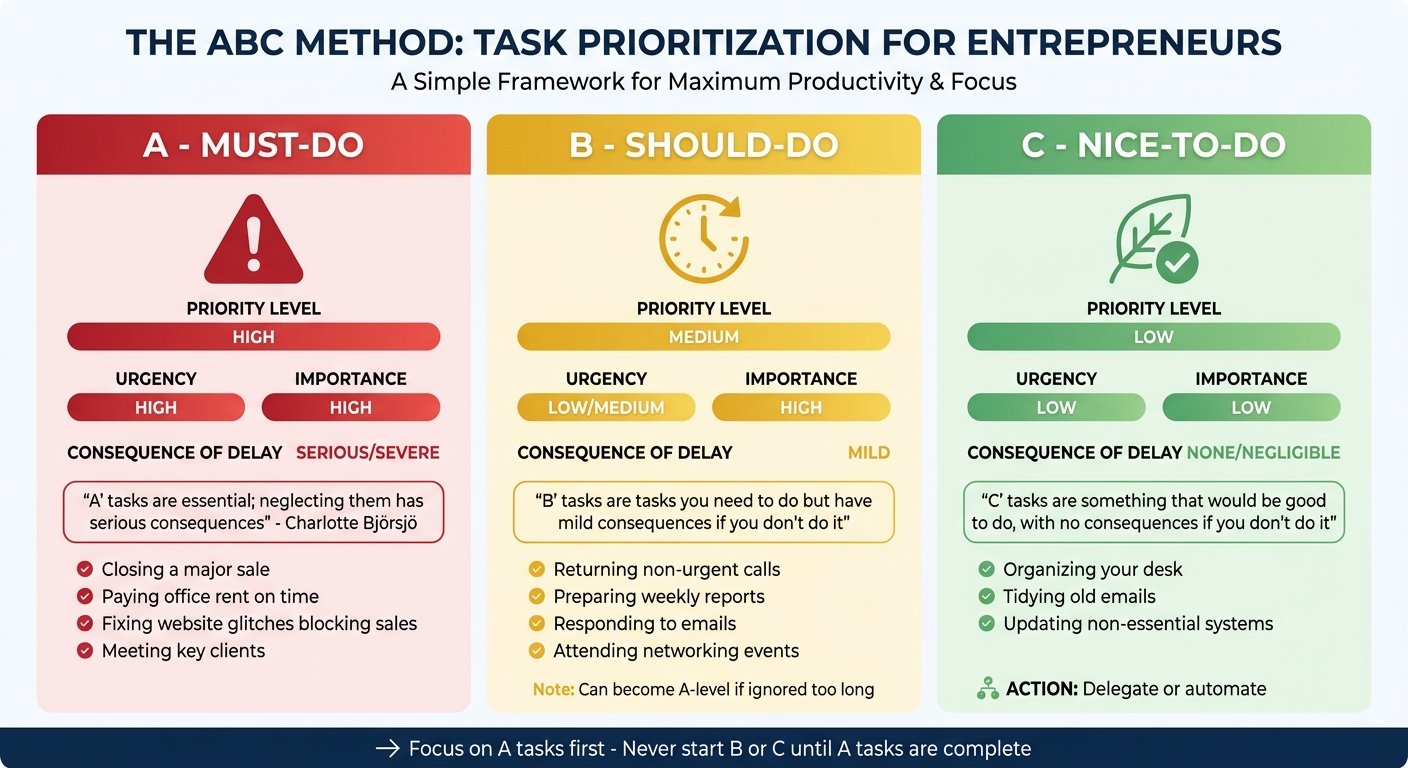
ABC Method Task Prioritization Categories Comparison Chart
The ABC Method helps you prioritize tasks by sorting them into three groups based on urgency and impact. This approach ensures your focus stays on what truly drives your business forward.
Category A: Must-Do Tasks
Category A tasks are non-negotiable. Ignoring them could lead to major consequences, such as lost revenue, legal trouble, or damaged client relationships. These tasks are directly tied to critical business outcomes like maintaining operations, securing income, or keeping clients happy.
Charlotte Björsjö, Project Manager at Zooma, sums it up perfectly:
"'A' tasks are essential; neglecting them has serious consequences".
Think of tasks like closing a major sale, paying your office rent on time, or fixing a website glitch that’s stopping customers from buying. If skipping a task could result in significant setbacks, it belongs in Category A.
Category B tasks, while important, don’t carry the same immediate weight.
Category B: Should-Do Tasks
Category B tasks are important for long-term success but don’t demand immediate attention. Delaying these tasks might cause minor inconveniences, but they won’t derail your business.
"'B' tasks are tasks you need to do but have mild consequences if you don't do it. Someone might be unhappy if you don't do it, but they are secondary in urgency".
Examples include returning non-urgent calls, preparing a weekly report, or attending an industry networking event. While these tasks are less pressing, they can become A-level priorities if ignored for too long.
Finally, there’s Category C, which focuses on tasks with minimal impact.
Category C: Nice-to-Do Tasks
Category C tasks are the least critical. Skipping them has little to no effect on your business objectives or bottom line. These tasks might feel productive, but they don’t contribute significantly to your goals.
"'C' tasks are something that would be good to do, with no consequences if you don't do it".
Examples include tidying up your desk, organizing old emails, or updating non-essential systems. To save time and energy, consider delegating or automating these tasks whenever possible. This keeps your attention on higher-impact work.
How to Use the ABC Method
The ABC Method is most effective when followed through a structured, step-by-step approach.
Step 1: List All Your Tasks
Start by writing down every single task you need to handle - from major projects like budget planning to smaller, routine activities. Be thorough and even break big projects into smaller, more manageable pieces. Keep this list centralized in one place, whether that's a notebook, an app, or a spreadsheet. Studies show that 80% of the average workday is often spent on tasks that add little to no value. This list will serve as the foundation for categorizing your tasks effectively.
Step 2: Assign Each Task an A, B, or C Label
Once your list is ready, assign a category to each task based on its consequences if left undone. Be careful not to label tasks as "A" just because they feel urgent - ensure they also align with your business goals.
Here’s a quick overview of the categories:
| Category | Priority | Urgency | Importance | Consequence of Delay |
|---|---|---|---|---|
| A | High | High | High | Serious/Severe |
| B | Medium | Low/Medium | High | Mild |
| C | Low | Low | Low | None/Negligible |
Step 3: Rank Tasks Within Each Category
After categorizing, prioritize tasks within each group. Number them by importance, with A-1 being the highest priority. Your A-1 task is the most critical and carries the heaviest consequences if ignored. As Charlotte Björsjö, Project Manager at Zooma, explains:
"A-1 task is your most important one."
Revisit these rankings daily. Priorities can shift based on changing business needs or market conditions, so staying flexible is key. Always tackle A-1 tasks before moving on to lower-ranked ones.
Step 4: Complete A Tasks First
With your rankings in place, focus on completing all A tasks before touching B or C tasks. Some people find it helpful to block out uninterrupted time specifically for A tasks. Others take it a step further by dedicating entire days to A tasks, leaving B and C items for later. This approach helps maintain focus and reduces distractions, allowing you to make meaningful progress.
Step 5: Delegate or Drop C Tasks
C tasks often take up time without contributing significantly to your goals. Whenever possible, delegate these tasks to others or automate them. If a task has no real consequence and can’t be delegated, it might be best to remove it from your list altogether. Freeing yourself from low-impact tasks allows you to concentrate on work that truly matters.
Benefits of Using the ABC Method
The ABC Method does more than just organize priorities - it brings a range of advantages that can help businesses achieve faster growth and improved efficiency.
More Focus on High-Value Work
One of the standout benefits of the ABC Method is its ability to direct attention to tasks that make the biggest impact on revenue and growth. By dedicating your most productive hours to these high-priority projects, you can achieve greater results. For example, Barbara Corcoran, the real estate expert and "Shark Tank" investor, applies this system daily. In 2023, she reported identifying five to seven "A" tasks each morning, treating them as unmissable priorities.
This approach not only ensures that your energy is spent wisely but also aligns with the Pareto Principle - where 20% of your efforts often yield 80% of the outcomes. By focusing on A-level tasks during your peak performance hours, you can avoid wasting valuable time on less impactful work.
Less Stress and Overwhelm
Separating tasks into A, B, or C categories eliminates the constant need to decide what to tackle next, easing mental strain and reducing decision fatigue. Kapil Garg, Founder of Clockdiary, highlights this benefit:
"Constant urgency increases decision fatigue. This method gives you a clear order of importance so you always know what to work on next."
This clarity also provides peace of mind. Even if some tasks remain unfinished by the end of the day, knowing that you've completed the most critical ones can reduce stress. It ensures that your focus stays on what truly matters, leaving less room for second-guessing.
Better Time and Resource Use
The ABC Method also helps you make smarter use of your resources. By prioritizing tasks that drive meaningful results, you can allocate time, team efforts, and finances more effectively.
High-profile leaders like Richard Branson of Virgin Group and Kenneth Chenault, the former CEO of American Express, have used the ABC Method to manage their demanding schedules. This approach also combats the tendency to focus on trivial tasks - a phenomenon known as bikeshedding - and keeps your attention firmly on activities that align with your goals. When you know exactly what deserves your energy, every minute becomes more impactful.
Tips and Common Mistakes to Avoid
Even though the ABC Method is straightforward, entrepreneurs often run into common issues. Knowing these challenges ahead of time can help you get the most out of the system.
Review and Update Your List Daily
Business priorities can change in the blink of an eye. A task that feels like a low-priority "C" on Monday might become critical by midweek if deadlines shift or market conditions evolve. That’s why it’s essential to review your task list every morning. Adjust your "A" tasks by the end of each day to reflect what needs your immediate attention. Once your list is up-to-date, focus on delegating tasks that others can handle.
Delegate B and C Tasks When Possible
Trying to do everything yourself is a productivity killer. Studies show that 80% of the average workday is spent on tasks that don’t add much value. If you manage a team, pinpoint "B" and "C" tasks that align with your team members' strengths and hand those off. This allows you to focus on the high-impact work that only you can do. Delegating effectively keeps your task list manageable and ensures you're sticking to the ABC Method's emphasis on meaningful work.
Don't Overload Category A
Streamlining your task list is helpful, but there’s a trap you need to avoid: overloading your "A" category. This is one of the most frequent mistakes people make. When every task is labeled as urgent, none of them truly are. A bloated "A" list often signals that your priorities are unrealistic. Reserve "A" for tasks that come with serious consequences if left undone. If you find yourself with multiple "A" tasks, rank them as A-1, A-2, A-3, and so on. Focus on completing your A-1 task fully before moving to the next. Keeping your "A" category lean ensures the system works as intended, helping you stay focused on what truly matters. This disciplined approach minimizes distractions and keeps your momentum strong.
Conclusion
The ABC Method offers entrepreneurs a clear way to cut through distractions and focus on what truly matters. By zeroing in on "A" tasks, using "B" tasks to support progress, and minimizing time spent on "C" tasks, you create a system that aligns your efforts with meaningful business results. This approach allows you to reclaim your time and channel it into the 20% of activities that deliver 80% of your outcomes.
What makes this method practical is its ability to fit into any workflow. You can refine it further by sub-ranking your "A" tasks or pairing it with other productivity strategies. The real challenge lies in staying disciplined: completing your most critical task before moving on. As Barbara Corcoran points out, labeling something as an "A" task is a way of committing to its completion.
To put this into action, start tomorrow morning by listing your tasks, assigning them letters, and tackling your top "A" task first. Keep your "A" list short, review it daily as priorities shift, and either delegate or eliminate tasks that don’t align with your goals. The ABC Method is all about focusing on the work that truly drives your business forward.
At FromZeroToGrow, we believe disciplined prioritization is at the heart of lasting success. The ABC Method is one tool to help you build that discipline and reshape how you approach each workday.
FAQs
How many A tasks should I pick each day?
Focus on selecting 1 to 3 A-level tasks each day - those that are both critical and time-sensitive. By prioritizing these, you're ensuring that your energy goes toward the actions that truly move the needle and make a real impact.
What if a B task suddenly becomes urgent?
If a task initially classified as a B task becomes urgent, it should be reclassified as an A task. This adjustment highlights its new level of importance and ensures it gets the priority and focus it now demands.
How do I delegate C tasks if I don’t have a team?
If you're working solo, handling C tasks requires a bit of strategy. Start by reassessing their actual importance - many of these lower-priority items can often be postponed, combined with similar tasks, or even removed altogether. The key is to dedicate your energy to higher-priority tasks first. If any C tasks still need attention, schedule them for a later time. This approach aligns perfectly with the ABC Method, which focuses on tackling tasks based on their urgency and significance.